

Not for the fainthearted. The status of paid caregivers for older people working for Programa Maior Cuidado in Brazil. [1]
By Peter Lloyd-Sherlock and Fialho de Carvalho
March 2025
In high-income countries, paid caregiving for older people has been one of the fastest growing areas of employment over the past 30 years. In the European Union, for example, around seven million people have jobs in this sector (Barslund, 2021). The vast majority of this workforce receive low pay, have limited training, lack labour rights and are exposed to exploitative practices (ILO, 2015; Gould, Sawo and Banerjee, 2021). And the vast majority of this workforce are women, with some studies estimating they make up 90 per cent of this low status workforce (Behtoui et al, 2020).
In many low and middle-income countries, including Brazil, numbers of older adults who require some form of care or assistance with their daily lives are increasing fast. Most of these people are cared for at home by family members on an unpaid basis. Despite this, there are signs of rapid growth in paid caregiving, often provided by private nursing and home-help agencies. There has also been a rapid increase in the number of residential care homes. For example, it is estimated that there are at least 8,000 such care homes currently operating in Brazil (Wachholz et al, 2021). There is little information about this new care workforce in countries like Brazil, but the limited evidence indicates that conditions are as bad as in high-income countries, if not worse (Küchemann & Pfeilsticker, 2020).
Along with other academic colleagues and partners in different government agencies, we have been evaluating and extending a new kind of care service for poor older people in Brazil: Programa Maior Cuidado (PMC). For more details about PMC, please see the links at the end of this brief. Among other things, PMC recruits, trains and deploys paid caregivers (called “social carers”) to assist older people living in slum neighbourhoods with care needs. Social carers work closely with local primary health care and social service staff to improve more general service provision for these older people and their families.
Potentially, PMC may be able to do much to reduce the pressure on family caregivers, most of whom are women and get no other form of assistance in managing this challenging and exhausting responsibility. We are studying these potential effects. We are also interested in the work experiences of the social carers employed by PMC and recently held group discussions with them. We were keen to find out whether they felt that PMC gave them a professional status and respect, or whether their experiences are similar to those of others in this low-status, undervalued workforce.
We only completed this series of discussions a few weeks ago and are still to analyse the information in depth. However, we have already identified some interesting insights which we will now present in this short brief:-
Some PMC social carers had previous experience of paid care, either as agency staff or in care homes. Many found being in PMC more rewarding than working in an institutional setting.
When you work in a hospital or care home, you give one person a bath and then you’re straight onto the next person. In PMC, we’re able to spend more time talking with the older person. We can pay attention and listen to them. This makes a big difference.
PMC is a government funded scheme which targets the most vulnerable families living in favela neighbourhoods. All social carers are required to take a training course which aimed to prepare them for these difficult social contexts, as well as more technical aspects of caregiving.
I was really amazed when the training course started. I’ve done nursing assistant courses before, but they didn’t teach me any of the important things I learned on this PMC course. It was a completely different experience, and so important for helping us cope with the realities of the job.
Social carers often faced challenging situations when visiting PMC families, including problems of addiction, violence and poor mental health. Building trusting relationships required sensitivity, care and patience.
I’ve had to deal with some situations in people’s homes that were not at all OK. But I feel families have come to respect me. When I first start visiting, the other family members usually think that I will take over doing everything for them… So at the start I sometimes have to be quite firm with them about [about mutual responsibilities]. And over time this starts to work better.
A key element of PMC is that social carers are not left to deal with these issues on their own. PMC supervisors offer support and become directly involved when problems arise. Social carers also have close relationships with local primary health care and social services teams.
Thank God that we can count on the support of the CRAS (local social services team). They’re a strong team and really have my back. And the health post, behind the scenes, we can count on them too, and that makes all the difference to our work.
I have the phone number a community health worker from the local health post. Any problem, any advice I need I can call her cell phone and we’re in touch. Sometimes I don’t even need to go to the health post. I let them know about a particular case and they sort out the consultations. Then they send me the details. It’s really cool.
Any problem and I can talk with my supervisor and they will come to my rescue. This didn’t happen so much when I worked in care homes.
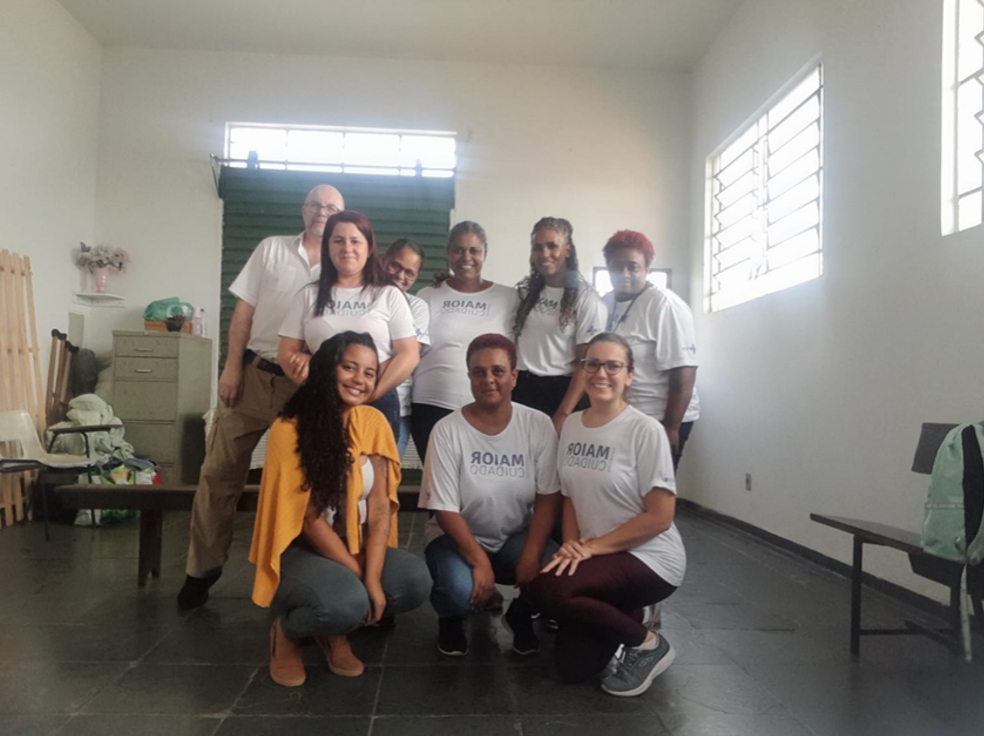
The formal link between social carers and other health and social care professionals was a key difference from caregivers working for private agencies. PMC had only just begun to operate in some of the neighbourhoods we studied. It took some time for social carers to be accepted by their co-workers, but over time their role became increasingly understood and valued. Social carers were required to wear a PMC shirt at all times they were working, and this included badging for the municipal health and social care departments as well as the Ministry of Health. It was widely agreed that this “uniform” increased their status in the community and among co-workers.
When you first start working at the health and social services posts, you have to understand that you’re a newbie, an outsider. You’re not going to win everybody over straight away, it takes time. You need to build their confidence in you.
The PMC shirt is taken very seriously. These days the staff in the health post treat me very differently because of this shirt. But this shirt also gives us a special responsibility. We’re on display. We have a large burden on our shoulders.
These initial insights from our discussions with PMC social carers give a sense of the role’s challenges and responsibilities. and value their contributions. As the title for this research brief states, social caregiving is not a job for the fainthearted. Looking after care-dependent older people is never an easy job, and working with vulnerable families in deprived neighbourhoods adds an extra level to this challenge. Without wishing to glamourise their experiences, the social carers often found the job to be highly rewarding and motivating. Rather than working in isolation, they felt part of a wider team which came to respect their contributions.
[1] This study was funded by the Grupo de Análisis para el Desarrollo.
[2] By the way, almost all the PMC social carers are women, despite best the scheme’s best efforts to recruit men. We discuss this issue in a separate research brief (https://cuidadosa.org/wp-content/uploads/2025/02/EDITADO-Gender-norms-research-brief.pdf).
REFERENCES
Cafagna G., Aranco N., Ibarrarán P., Oliveri M., Medellín N. And Stampini M. (2019) Age with Care: Long-term Care in Latin America and the Caribbean. Inter-American Development Bank https://publications.iadb.org/en/age-care-long-term-care-latin-america-and-caribbean
P.Lloyd-Sherlock, S.Sasat, F.Morales and A.Pot (2017) “Long-term-care policy in Thailand and Costa Rica and the role of volunteers: Key success factors for development and implementation”. Bulletin of the World Health Organisation 95(11): 774–778.
Sartini CM, Correia AM. Programa Maior Cuidado: qualificando e humanizando o cuidado. Pensar/BH Política Social, 2012;31:10-13.
ALL POSTS